The coastline within a 10-minute drive of Calonge holds some of the most beautiful coves on the Costa Brava. Cala Margarida, Platja de la Fosca, Cala Estreta, and Cala dels Canyers deliver crystal-clear Mediterranean water, pine-forested cliffs, and a fraction of the crowds found at Lloret de Mar or Platja d’Aro. Knowing which beach suits your group — and exactly when to show up — makes the difference between a perfect morning and a frantic parking search.
The Costa Brava’s southern stretch, running between Palamós and Platja d’Aro, is where these coves are concentrated. They range from the easily accessible Cala Margarida (100 meters of pebble shoreline flanked by fishermen’s houses) to the genuinely wild Cala Estreta, reachable only on foot via the Camí de Ronda coastal path. Each one rewards a visitor who knows what they’re looking for.
This guide covers the four best coves near Calonge: what makes each unique, how to reach it from the villa, the best time to go, and what to bring. Plan these beaches in advance and your Costa Brava trip will look very different from the standard package-holiday experience.
Key Takeaways
- Cala Margarida is a 100-meter pebble cove, approximately 5 minutes from Calonge, with historic fishermen’s houses lining the shoreline.
- Platja de la Fosca stretches 500 meters, offers calm shallow water ideal for young children, and has kayak and paddleboard rental available on-site. It holds Blue Flag status.
- Cala Estreta sits 8 km from Palamós center and requires a 20-30 minute walk along the coastal path from Platja de Castell; no services on-site.
- The Camí de Ronda (GR-92 coastal path) connects all the coves between Palamós and Platja d’Aro and is the most scenic way to reach the wilder spots.
- The sea swimming season at Calonge and Palamós runs from June through October, with water reaching 24.5°C on average in August.
- June and September are the best months to visit: warm water, noticeably fewer visitors than July or August, and parking that is actually manageable.
- Parking at every accessible cove is extremely limited; arriving before 9:00 AM or after 5:00 PM is the only reliable strategy in peak summer.
- Five beaches within 5-7 minutes of Villa Joia del Mar hold Blue Flag status, confirmed annually by ADEAC (Spain’s Blue Flag authority).
Why Costa Brava Beaches Are Different from the Rest of Spain
The Costa Brava — Catalonia’s 214-kilometer coastline running through the province of Girona — gets its name, ‘the wild coast’, from its rocky, rugged shoreline. Unlike the flat, developed beaches of the Costa del Sol or Costa Dorada, the Costa Brava’s geology produces a constant succession of small coves separated by forested headlands and limestone cliffs. The result is a coastline where Mediterranean pines grow down to the waterline and the sea shifts from pale turquoise in the shallows to deep cobalt further out.
The water clarity here is exceptional. The rocky seabed reflects light differently than sand, and the limited river input keeps suspended particles low. Most coves near Calonge score Blue Flag status, which requires documented water quality testing across the entire season. Visibility underwater often exceeds 10 meters, making these beaches particularly suited to snorkeling even without specialist equipment.
The southern Costa Brava — the stretch from Palamós south toward Platja d’Aro — also benefits from the Camí de Ronda, a centuries-old coastal path (now marked as GR-92) that once served as a smugglers’ and customs officers’ route. Today this path links every cove in the area, allowing visitors to reach beaches that have no road access and consequently see far fewer visitors than anything reachable by car.
Beaches Near Calonge at a Glance
The table below summarises the key characteristics of the beaches covered in this guide. All distances are measured from Calonge / Sant Antoni de Calonge.
| Beach | Length | Seabed | Blue Flag | Services | Access | Drive from Calonge |
| Cala Margarida | ~100 m | Pebble + rock | No | None on-site | Car / 15 min walk from Palamós Marina | ~5 min (4 km) |
| Platja de la Fosca | ~500 m | Sand + pebble | Yes | Bar, toilets, kayak/SUP rental | Car | ~7 min (5 km) |
| Sant Antoni de Calonge | ~1,200 m | Fine sand | Yes | Full services | Car / walking from village | ~5 min (3 km) |
| Torre Valentina | ~300 m | Sand | Yes | Bar, sun loungers, lifeguard | Car | ~6 min (4 km) |
| Es Monestrí | ~200 m | Sand | Yes | Basic services | Car | ~7 min (5 km) |
| Cala dels Canyers | ~60 m | Rock | No | None | Walk only (15 min from Platja de Castell) | ~10 min + 15 min walk |
| Cala Estreta | ~80 m | Rock | No | None | Walk only (25 min from Platja de Castell) | ~10 min + 25 min walk |
Sources: ADEAC Blue Flag programme (banderaazul.org), 2024-2025 lists; Generalitat de Catalunya (gencat.cat), Blue Flag beach register 2024; municipality data for Calonge i Sant Antoni and Palamós.
Cala Margarida: The Closest Jewel
Cala Margarida is the easiest of the hidden coves to reach from Calonge and arguably the most visually distinctive. The cove sits just north of Palamós Marina, tucked behind Cap Gros headland, and measures approximately 100 meters long by 10 meters wide. The shoreline is pebble and coarse sand — rubber-soled water shoes are strongly recommended — and the seabed drops away quickly, giving the water an intense blue color even close to shore.
What sets Cala Margarida apart from other coves on the Costa Brava is the row of traditional fishermen’s houses that frame the beach. Most date from the 19th and early 20th centuries and have been converted into summer residences. Colorful fishing boats still pull up on the pebbles, giving the cove a working-maritime character absent from the more tourist-developed beaches nearby. The islets of La Negra and La Figuera Borda sit directly opposite the beach and provide good snorkeling sites for swimmers willing to cover the short distance.
From the southern end of the cove, the Camí de Ronda continues over Cap Gros headland toward Platja de la Fosca. The walk takes approximately 20 minutes and passes through pine forest with open sea views. Cala Margarida is reachable by bus from Palamós town center or on foot from the marina in about 15 minutes. Parking near the cove is extremely limited — fewer than 50 unregulated spaces — so arriving by 9:00 AM is essential in July and August.
Platja de la Fosca: Best for Families
Platja de la Fosca is the only beach on this stretch that combines genuine natural beauty with a reliable set of family services. The beach runs approximately 500 meters in length and consists of pale sand with a gradual depth gradient — the shallow zone extends far enough for young children to wade safely without supervision. The characteristic large dark rock that divides La Fosca from the adjacent Platja de Sant Esteve de la Fosca gives the beach its name (‘La Fosca’ means ‘the dark one’ in Catalan).
La Fosca holds Blue Flag status — awarded annually by ADEAC based on documented water quality tests, environmental management, and safety standards. The classification confirms consistently clean water throughout the entire season. Water sports rental operates directly from the beach throughout June to September. Kayak hire typically runs at around 10-15 euros per hour for a two-person vessel; paddleboard rental is in the same range. The seafront promenade behind the beach has several bars and restaurants with terrace seating.
Platja de la Fosca connects to Cala Margarida via Cap Gros headland to the south and to Cala S’Alguer and Platja de Castell to the north via another section of the Camí de Ronda. The path north from La Fosca passes the ruins of Sant Esteve Castle perched on a cliff above the sea, and the walk to Platja de Castell takes approximately 40 minutes. Parking at La Fosca is easier than at Cala Margarida, with a larger unregulated area, but still fills by mid-morning in peak season.
Cala Estreta and Cala dels Canyers: Wild and Untouched
Cala Estreta is the most remote of the coves accessible from Calonge without a boat. It sits 8 km north of Palamós center and has no road access — the only way to reach it is a 20-30 minute walk along the Camí de Ronda from Platja de Castell. The effort is worth it. Cala Estreta is a narrow cove divided by a prominent rock formation called ‘La Roja’ (the red one), named for the reddish color of the stone. There are no services, no lifeguard, and no commercial activity of any kind. Nudism is permitted and commonly practiced.
The seabed at Cala Estreta is entirely rocky, making it exceptional for snorkeling. The absence of sand means the water maintains its clarity even in windy conditions, and the rock formations provide habitat for sea urchins, octopus, and a range of Mediterranean reef fish. An additional rock in the middle of the cove creates a natural pool at low swell, ideal for confident swimmers who prefer calmer water.
Cala dels Canyers (also written as Cala Canyers) lies along the same coastal path, between Platja de Castell and Cala Estreta. It is smaller than Cala Estreta, with a more sheltered aspect and slightly less dramatic scenery. Both coves are best visited in the morning, when the sun hits the water directly and before the small number of visitors who make the walk begins to accumulate. A swimsuit, water shoes, drinking water, and sunscreen are the essential kit — there is nothing available for purchase once you leave the car park at Platja de Castell.
How to Get to Each Beach from Calonge
All four coves sit within a 15-minute drive of Calonge. The village of Calonge itself is set slightly inland; the coastal settlement of Sant Antoni de Calonge lies at the foot of the hill. From both, the quickest route north toward Palamós and the coves takes the GI-662 coastal road.
| Beach | Drive from Calonge | Parking | On Foot from Previous Beach |
| Cala Margarida | ~5 min (4 km) | Under 50 spaces, free, fills by 9:00 AM in summer | 15 min from Palamós Marina |
| Platja de la Fosca | ~7 min (5 km) | Larger unregulated area, fills by 10:30 AM in summer | 20 min from Cala Margarida via Cap Gros path |
| Platja de Castell | ~10 min (8 km) | Paid car park (open June-September) | 40 min from La Fosca via Camí de Ronda |
| Cala dels Canyers | ~10 min to Castell + 15 min walk | Park at Platja de Castell | 15 min north of Castell on Camí de Ronda |
| Cala Estreta | ~10 min to Castell + 25 min walk | Park at Platja de Castell | 10 min north of Cala dels Canyers |
Driving times measured from Calonge village center. Walking times on the Camí de Ronda are estimates at a relaxed pace without swimming stops.
The Camí de Ronda: Connecting the Coves
The Camí de Ronda (GR-92) is the historic coastal path that links all beaches in this guide. Originally used by the Guardia Civil to patrol the coastline against smuggling, today it is a marked hiking trail running 583 km along the entire Catalan coast. The section between Palamós and Platja de Castell is one of the most walked stretches on the southern Costa Brava.
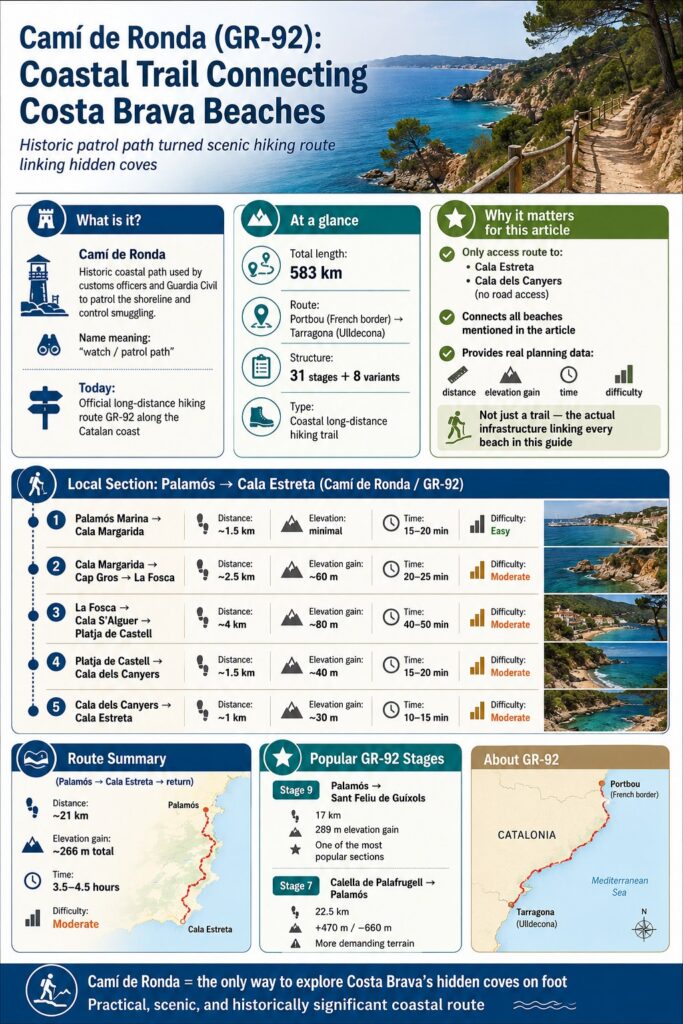
A practical one-day route from Calonge: drive to Palamós Marina, walk to Cala Margarida (15 min), continue over Cap Gros to La Fosca (20 min), then walk the seafront promenade north to Cala S’Alguer and on to Platja de Castell (40 min). From Platja de Castell, the path north reaches Cala dels Canyers (15 min) and Cala Estreta (a further 10 min). Allow a full morning for this route and arrange a car at both ends, or plan the return walk. Total walking time from Palamós to Cala Estreta and back is approximately 3.5 to 4.5 hours at a relaxed pace with stops.
Beating the Crowds – Timing and Insider Tips
July and August bring the highest visitor numbers to every beach on the Costa Brava. Peak weeks — the last two weeks of July and the first two of August — see Palamós and the surrounding area fill with French, German, Dutch, and Spanish holiday-makers simultaneously. Cala Margarida and Platja de la Fosca, accessible by car, show the effects most strongly. Cala Estreta and Cala dels Canyers, requiring a 20-30 minute walk, are considerably quieter even in peak weeks.
June and September are the optimal months for visiting these coves. The data below shows why: water temperatures are fully swimmable from June onward, and the gap between June/September conditions and the August peak is minimal — while the crowd difference is substantial.
Sea Water Temperature at Calonge and Palamós by Month
The following data reflects average sea surface temperatures recorded over a 10-year period at the coast of Palamós, directly applicable to Calonge and Sant Antoni de Calonge — all located on the same bay (Bahía de Palamós).
| Month | Average | Minimum | Maximum | Swimming |
| January | 13.7°C | 12.0°C | 15.4°C | No |
| February | 13.0°C | 11.9°C | 14.0°C | No |
| March | 13.2°C | 11.9°C | 14.6°C | No |
| April | 14.2°C | 12.1°C | 17.0°C | No |
| May | 16.7°C | 14.2°C | 21.2°C | No |
| June | 20.5°C | 16.0°C | 25.5°C | Yes |
| July | 23.6°C | 20.3°C | 26.9°C | Yes |
| August | 24.5°C | 21.9°C | 28.0°C | Yes |
| September | 23.0°C | 20.0°C | 27.1°C | Yes |
| October | 20.1°C | 16.5°C | 23.9°C | Yes |
| November | 17.1°C | 13.9°C | 20.4°C | No |
| December | 14.9°C | 13.1°C | 17.0°C | No |
Source: SeaTemperature.info / seatemperature.info/palamos-water-temperature.html — 10-year historical average based on satellite and in-situ observations. Data applies to all beaches on the Bahía de Palamós including Calonge, Sant Antoni de Calonge, and Palamós.
Seasonal averages: winter 13.9°C, spring 14.7°C, summer 22.9°C, autumn 20.1°C. The swimming season runs five full months — June through October. Sea salinity at Palamós is 37.86 per mille, slightly above the world ocean average of 35 per mille, which contributes to the distinctive clarity of the water.
Within peak season, timing within the day matters considerably. Arriving at any of the accessible coves before 9:00 AM almost always secures a parking space. The hour after 5:00 PM is a second window — families with children begin leaving by late afternoon, and the light at that time is exceptional for photography. Midday in July and August, from roughly 11:00 AM to 4:00 PM, is the worst time to arrive at any beach in the area. The walk to Cala Estreta should be done in the morning — not only to avoid the midday heat but to catch the best light on the water.
One additional tip: the Platja de Castell car park, which serves as the starting point for the walk to Cala Estreta and Cala dels Canyers, operates as a paid facility during summer. Fees are modest (typically under 5 euros for a half-day) but the car park fills early regardless. If it is full, there is limited unregulated parking on the road approaching the beach, but this requires a longer walk and should be considered a backup rather than a plan.
Your Base: A Villa with Pool for Rest Days
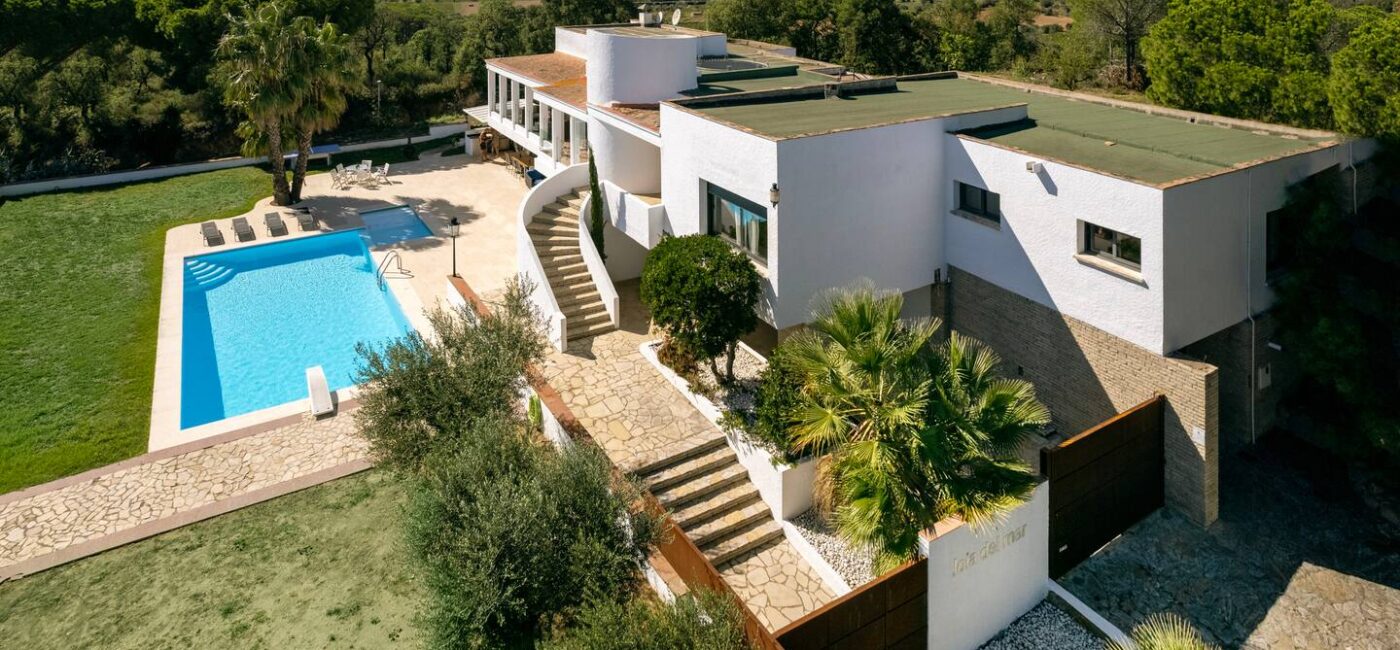
Not every day needs to be a beach day. The Mediterranean sun at this latitude is intense from late June onward, and having a private pool at Villa Joia del Mar means the best version of a rest day is available without leaving the property. The villa’s pool deck faces away from the road, giving an uninterrupted backdrop of garden and sky. The Adirondack chairs, sun loungers, and BBQ area function as a second outdoor living room — useful on the one or two days per week when even a beach walk feels like too much effort.
Villa Joia del Mar sits in Calonge, 10 minutes on foot from Sant Antoni de Calonge’s seafront and 5 minutes by car from Palamós. The position means that every cove in this guide is reachable as a morning excursion, with the option to return to the villa for lunch, a rest, and a late-afternoon swim in the pool before dinner. This combination — private base plus wild coastline within reach — is what a villa near Calonge offers that no hotel in the area can replicate.
Five beaches within a 7-minute drive hold Blue Flag status — the internationally recognized award for clean water, environmental management, and visitor safety, confirmed each year by ADEAC (Asociación de Educación Ambiental y del Consumidor), Spain’s Blue Flag authority. That concentration of certified beaches within a single short drive is one of the strongest practical arguments for choosing this stretch of coast over better-known alternatives.
Book Villa Joia del Mar and explore Costa Brava‘s most beautiful coves with a private base to return to every afternoon.
Frequently Asked Questions
Is Cala Margarida near Calonge suitable for swimming?
Yes, Cala Margarida is suitable for confident swimmers. The seabed is rocky and drops away relatively quickly, so shallow-water paddling is limited. Water shoes are essential given the pebble and stone composition of the shoreline. The cove is sheltered by Cap Gros headland, so swell is minimal in normal conditions. Cala Margarida is not recommended for very young children who cannot swim; Platja de la Fosca is the better option for families with toddlers.
Can you walk between the beaches from Calonge on foot?
Yes. The Camí de Ronda (GR-92) coastal path links Cala Margarida, Platja de la Fosca, Cala S’Alguer, Platja de Castell, Cala dels Canyers, and Cala Estreta in a continuous route. Walking from Cala Margarida to Cala Estreta takes approximately 1.5 to 2 hours at a relaxed pace. From Sant Antoni de Calonge itself, the Camí de Ronda also connects south toward Platja d’Aro, offering another direction for exploration.
Are there toilets and restaurants at the hidden coves near Calonge?
Platja de la Fosca has public toilets and several beach bars on the seafront promenade. Cala Margarida has no public toilet facilities on-site; the nearest are at Palamós Marina, a 15-minute walk south. Cala Estreta and Cala dels Canyers have no services whatsoever — no toilets, no food, no drinking water. Visitors to the wilder coves must bring everything they need and carry all waste out.
What is the water temperature at Costa Brava beaches near Calonge?
Based on 10-year historical data, the sea at Palamós and Calonge averages 20.5°C in June, peaks at 24.5°C in August, and remains at 23.0°C in September. The swimming season runs from June through October — five months in which water stays at or above 20°C. February is the coldest month at an average of 13.0°C. The water is consistently clear thanks to the rocky seabed and relatively low suspended particle levels year-round.
Which beaches near Calonge have Blue Flag status?
Five beaches within 7 minutes of Calonge hold Blue Flag status in 2024-2025: Platja de la Fosca (Palamós), Sant Antoni, Es Monestrí, Cala Cristus-Ses Torretes, and Torre Valentina (all in Sant Antoni de Calonge municipality). The Blue Flag is awarded annually by ADEAC based on water quality tests, environmental management, safety standards, and visitor services. The wilder coves — Cala Margarida, Cala Estreta, and Cala dels Canyers — do not participate in the programme as they have no services infrastructure.
Is there parking near Cala Margarida and Platja de la Fosca?
Parking near Cala Margarida consists of fewer than 50 unregulated spaces near the Palamós Marina approach. In July and August, these fill by 9:00 AM on most days. Platja de la Fosca has a larger unregulated parking area that typically fills by 10:30 AM in peak season. Neither beach has a formal paid car park. For visitors staying at Villa Joia del Mar, arriving before 9:00 AM or using the local bus service from Palamós are the two practical solutions in midsummer.
Are the coves near Calonge crowded in summer?
Cala Margarida and Platja de la Fosca reach near-capacity on sunny July and August weekdays from around 11:00 AM onward. Cala Estreta and Cala dels Canyers, which require a 20-30 minute walk from Platja de Castell, remain considerably quieter even at peak times — the effort acts as a natural crowd filter. The sea swimming season runs from June through October, and June and September offer the best balance of warm water (above 20°C) and manageable visitor numbers.
Can you snorkel at the coves near Calonge?
Yes — snorkeling is one of the main draws of the rocky coves in this area. Cala Estreta is particularly good, with a rocky seabed, no suspended sand, and water clarity that frequently exceeds 10 meters visibility. The islets off Cala Margarida (La Negra and La Figuera Borda) also provide good snorkeling sites. Basic mask-and-fins equipment can be rented in Palamós town for around 10-15 euros per day, or purchased inexpensively at local sports shops.
Is the Camí de Ronda path accessible for all fitness levels?
Most sections of the Camí de Ronda between Palamós and Platja d’Aro are well-maintained and manageable for average fitness levels. The section over Cap Gros headland between Cala Margarida and La Fosca is the most demanding stretch near Calonge, with a short climb and uneven terrain. The section from Platja de Castell to Cala Estreta involves a gradual descent and return climb of around 100 meters elevation. Appropriate footwear — trail shoes or hiking sandals — is recommended. Standard flip-flops are not suitable for the wilder sections.