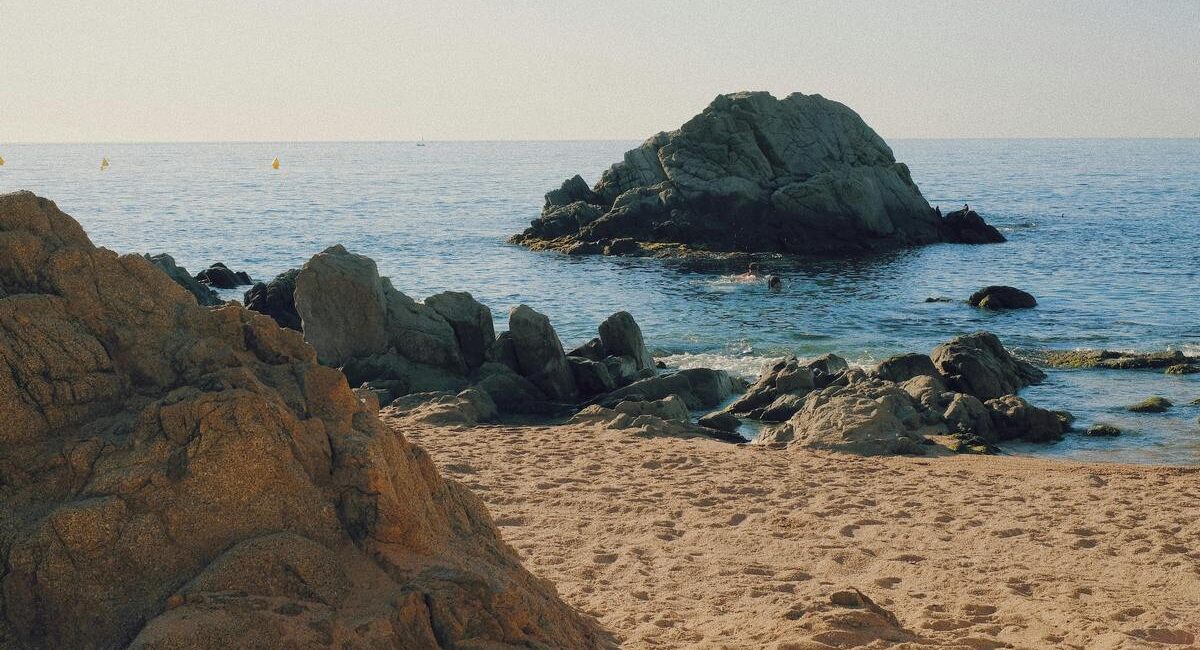
The Costa Brava is one of southern Europe’s strongest family vacation destinations, and for good reason. The Mediterranean Sea along this stretch of Catalan coastline is warm, calm, and shallow in the right places, the beaches carry Blue Flag ratings for safety and cleanliness, and the region holds an official Family Tourism Destination certification from the Catalan Tourism Agency. You get all of this within 45 minutes of Girona Airport.
The difference between a good Costa Brava family holiday and a stressful one comes down almost entirely to planning: which beaches you choose, which day trips you time correctly, and what kind of base you use. A sandy beach that delights a four-year-old can be completely wrong for a ten-year-old looking for snorkeling. Knowing those differences in advance removes most of the friction.
This guide covers everything: calm family beaches near Calonge and Palamós, age-specific activities from toddlers to teenagers, day trips worth making, where to eat with children, and why a private villa with a pool consistently outperforms hotels for families of four or more.
Key Takeaways
- June and September offer warm water, fewer crowds, and lower prices than July or August — the two ideal months for a Costa Brava family holiday.
- Platja de la Fosca (5 minutes from Calonge) and Sant Antoni de Calonge beach are the two best options for families with children under six: sandy, shallow, and sheltered.
- Aquadiver water park in Platja d’Aro is 20 minutes from Calonge, open June 10 to September 11, and offers 24 attractions across children, family, and thrill-seeker categories.
- Girona’s medieval Old Town (Barri Vell) is a 45-minute drive and works as a half-day trip for children aged 5 and up, with city walls to climb and narrow lanes to explore.
- A 5-bedroom private villa with pool accommodates 10 guests and typically costs less per night than five hotel rooms for the same party when booked for five nights or more.
- Cap de Creus Natural Park, 1 hour north of Calonge, is the best half-day nature excursion for families with children over 8 who can walk moderate coastal paths.
Why the Costa Brava Works So Well for Families
The Costa Brava’s main advantage over other Mediterranean family destinations is the variety of its coastline. Within a 30-kilometer stretch around Calonge and Palamós, you can choose between wide sandy bays with lifeguards and full services, shallow rocky coves for snorkeling, and quiet inlets shaded by Aleppo pines. That range means you can match the beach to the age of your children rather than compromising.
The Mediterranean along this part of the Catalan coast is warm from late May through early October. Water temperatures in July and August sit between 24°C and 27°C (75°F to 81°F), which means children can swim for extended periods without getting cold. There are no tides or Atlantic swells to worry about, and the water clarity is consistently high.
Several coastal municipalities in the region carry the Family Tourism Destination certificate issued by the Catalan Tourism Agency. This designation indicates that local businesses, beaches, and accommodation meet defined standards for child safety, including protected playground equipment, fenced beach areas, and trained beach monitors (monitores) during summer months at the main sandy beaches.
The pace of life is another factor. Spanish dinner culture means children are actively welcome in restaurants until 10 or 11 in the evening. Families eating at 9pm with kids running between outdoor tables is entirely normal rather than frowned upon. That social ease reduces the logistical pressure that often makes beach holidays with young children exhausting.

Calm Family Beaches Near Calonge and Palamós
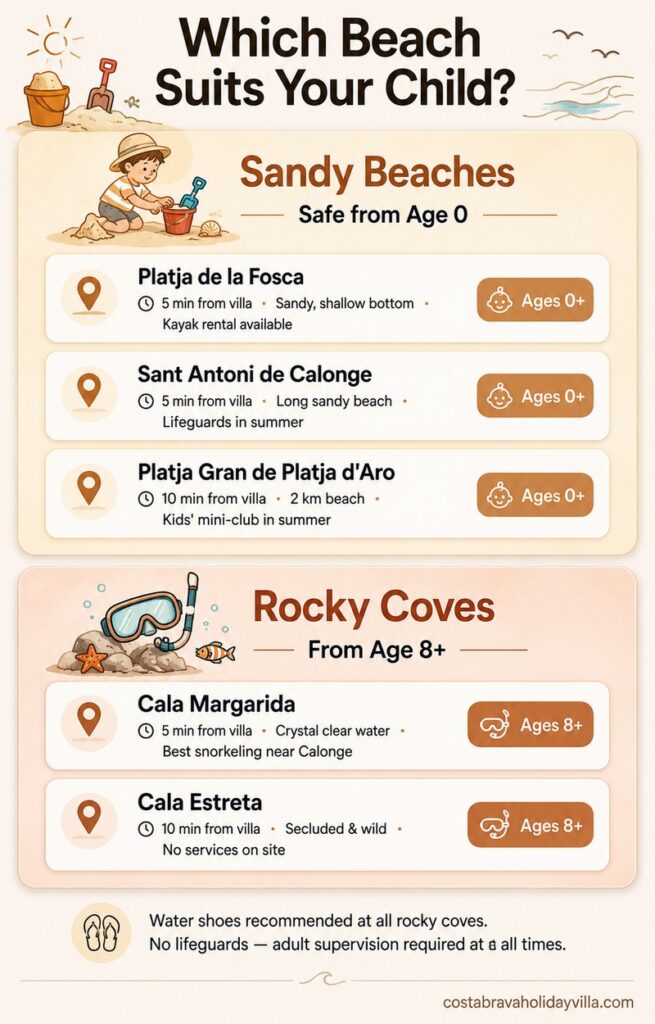
Not all Costa Brava beaches are suitable for young children, and it is worth knowing the difference before your first morning. The rugged northern section around Cadaqués and Roses has dramatic rocky coves that are beautiful for adults and strong swimmers but impractical with toddlers. The area around Calonge, Palamós, and Platja d’Aro is where the coast softens into the sandy, shallow beaches that families need.
Platja de la Fosca
Platja de la Fosca sits 5 minutes from the center of Calonge and is the strongest all-round option for families with children under ten. The beach is wide and sandy with a gently shelving bottom that stays shallow for the first 20 to 30 meters, giving young children safe paddling depth. Kayak and stand-up paddleboard rental is available from the beach kiosk during July and August. Parking is adequate on weekdays; arrive before 9:30am on summer weekends to secure a spot.
Sant Antoni de Calonge Beach
Sant Antoni de Calonge beach is the largest and most service-rich beach in the immediate area. The beach runs for over a kilometer with full lifeguard coverage in summer, shower facilities, sunbed and umbrella rental, and a row of waterfront restaurants and cafés. The water here is slightly more exposed than Platja de la Fosca but remains calm on most summer days. This is the right beach for families who want easy access to food and shade without organizing everything from the car.
Platja Gran de Platja d’Aro
Platja Gran de Platja d’Aro is 10 minutes from Calonge and is one of the best-equipped family beaches on the entire coast. The beach is over two kilometers long with fine golden sand, making it genuinely comfortable for children who want to run and dig. A mini-club operates on the beach during summer months with monitored activities for ages 4 to 12. An aquatic platform anchored offshore gives older children a jumping and climbing structure that works as a 30-minute focus point during beach afternoons.
Cala Margarida
Cala Margarida is 5 minutes from the villa by car and is the most photogenic beach in the immediate area. Crystal-clear water over a rocky and sandy bottom makes it ideal for snorkeling for children aged 8 and up. Parking is limited to roughly 40 spaces; arriving before 10am in July and August is essential. There are no services on the beach itself, so bring your own water and snacks. The payoff is some of the clearest water on the southern Costa Brava. For a full overview of the best coves and how to reach each one, see our guide to hidden coves and beaches near Calonge.
Activities by Age – What Works at Every Stage
The Costa Brava serves different age groups in genuinely different ways. Grouping activities by age rather than by location makes planning a mixed-age trip much easier.
Ages 0 to 3: Pool and Beach, in That Order
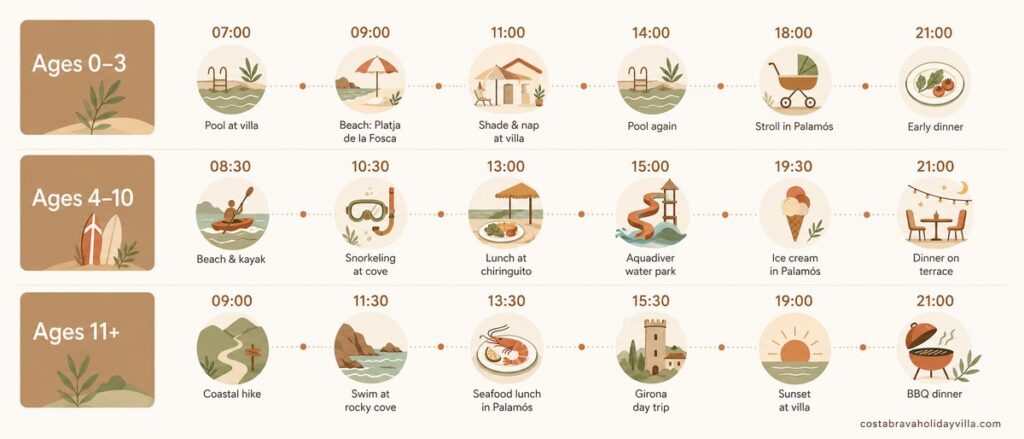
For children under four, the private villa pool is the primary daily activity, not a supplement to it. Beach trips with toddlers in July and August require careful timing: the best window is 8:30am to 11am before the heat peaks. After 11am, the temperature regularly exceeds 32°C (90°F) along the coast, and toddlers overheat quickly. A villa with a shaded pool area allows afternoon hours to be spent safely and without logistics. Sandy beaches like Platja de la Fosca and Sant Antoni de Calonge are the right choice for this age group; avoid rocky coves entirely.
Ages 4 to 10: Kayaking, Snorkeling, and Aquadiver
This age group gets the most out of the Costa Brava. Kayak rental is available at Platja de la Fosca and at several points along Platja Gran de Platja d’Aro, with two-seater family kayaks suitable from age 5. Snorkeling works well along the rocky edges of Cala Margarida and Cala Estreta, both within easy driving distance of Calonge. Children 6 and up who can put their face in the water will see sea bass, octopus, and starfish in shallow water with no specialized equipment beyond a basic mask and fins.
Aquadiver water park in Platja d’Aro (20 minutes from Calonge) is the single most popular structured activity in the region for this age group. The park has 24 attractions including a wave pool, a 250-meter Splash Mountain slide done in two-seater inflatable boats, a dedicated children’s area for under-8s with the Kids River and Fun Temple water playground, and a lazy river. Standard adult entry costs €37; reduced entry (children between 80cm and 120cm, and over-65s) costs €21; under 80cm enter free. The park runs from June 10 to September 11, 10am to 5:30pm.
Ages 11 and Up: Coastal Hiking, Sailing, and Girona
Older children and teenagers respond well to the Camí de Ronda, the historic coastal path that runs along the Costa Brava. The section between Calonge and Palamós is an easy 45-minute walk one way with sea views throughout. Sailing lessons for beginners are available through local schools in Palamós (5 minutes from Calonge), with weekend introductory courses starting at €80 per person. Girona city works well as a half-day trip for this age group: the medieval city walls include a walkable circuit at height, and the cathedral’s famous staircase tends to appeal to children who would find a standard museum visit tedious.
Day Trips Worth Making from Calonge
Calonge’s central position on the southern Costa Brava puts it within reach of several strong day trips. The distances are short enough that you can combine a morning trip with an afternoon beach return, which is the right structure for families who do not want to sacrifice beach time.
Girona (45 Minutes)
Girona is the strongest cultural day trip from Calonge for families. The Barri Vell (Old Town) is a compact medieval quarter with Roman walls, a 13th-century cathedral, and the Call Jueu, one of the best-preserved Jewish quarters in Europe. Children respond well to the city primarily because it is walkable at a comfortable pace, full of staircases and hidden passages, and contains multiple open squares where they can run freely while adults rest. The city walls offer an elevated walking circuit that takes roughly 30 minutes and gives a visual overview of the old town rooftops and surrounding countryside. Budget half a day for Girona: morning arrival, two to three hours of exploration, and lunch in the Rambla de la Llibertat before returning for a late-afternoon beach session.
Cap de Creus Natural Park (1 Hour)
Cap de Creus is the easternmost point of the Iberian Peninsula and the site of a dramatic natural park of volcanic rock, maquis shrubland, and hidden coves. The access road passes through the town of Cadaqués, one of the most visually distinctive villages on the coast, worth a 30-minute stop. The park itself is best experienced by a short walk out to the lighthouse at the cape, which involves 20 to 30 minutes of walking on well-maintained paths. This trip suits families with children aged 8 and up who can walk moderate terrain. The scenery is genuinely unusual and unlike anything else on the Costa Brava.
Aquadiver Water Park, Platja d’Aro (20 Minutes)
Aquadiver works best as a full-day commitment rather than a half-day. The park opens at 10am and closes at 5:30pm, and the drive from Calonge is 20 minutes. Families with children from 4 to 16 will find enough variation across the 24 attractions to fill the day without repeating. The children’s area for under-8s includes eight dedicated attractions including gentle spiral slides and an adventure lake. Pre-purchase tickets online before arrival: the standard gate price is €37 per adult, but multi-day family packages (2 adults + 2 children) are available for €95.
Family-Friendly Restaurants Near Palamós and Calonge
Spanish restaurant culture is genuinely family-friendly, and this applies across the Costa Brava without needing to seek out specifically child-targeted venues. Outdoor terrace seating is standard at most beachside restaurants from May through October. Children are expected and welcome at dinner. The key practical point is timing: local restaurants typically do not open for dinner until 8pm. Families who show up at 6:30pm looking for dinner will find closed kitchens.
Palamós, 5 minutes from Calonge, is one of the best fishing ports on the Costa Brava and the source of the region’s most celebrated product: the Palamós prawn (gamba de Palamós), which carries a protected designation of origin. Waterfront restaurants in Palamós serve grilled prawns and local seafood with a simplicity that children tolerate easily alongside pizza and pasta options. The Friday morning market in Palamós covers fresh produce, local olive oil, and prepared foods and is worth a visit for the sensory experience alone.
Chiringuitos, the beach-bar restaurants that operate along the coast in summer, are the easiest option for lunch with young children. Most serve a menu del día (daily set menu) at midday for €12 to €16 per adult, typically including a starter, main course, bread, and a drink. Children’s menus at chiringuitos usually include pasta, grilled chicken, and chips at €7 to €10. The advantage is location: most sit directly on or adjacent to the beach, which means children can return to the sand immediately after eating.
For families staying in a villa with a full kitchen, the Palamós fish market (Llotja de Peix) is worth a visit for those who want to cook. The auction hall is active in the early evening when the fishing boats return, and adjacent stalls sell the day’s catch at retail prices. Fresh fish grilled on a BBQ at the villa is one of the better food experiences a Costa Brava holiday produces, and it avoids the cost of a full family restaurant dinner.
Private Villa with Pool vs. Hotel for Families
For families of four or more, a private villa consistently outperforms a hotel across every practical dimension: space, cost, flexibility, and the daily experience of being on holiday with children. The comparison is not close.
Space is the most immediate issue. A 5-bedroom villa like Villa Joia del Mar in Calonge offers 5,200 square feet (484 m²) of indoor and outdoor living space for a group of up to 10. That space includes a large living room, a fully equipped kitchen, a private pool, a children’s playground, and a garden with a BBQ terrace. Two families splitting that villa for a week have a fundamentally different holiday experience from two families splitting two hotel rooms that share a corridor wall.
The private pool is the single feature that changes family life on holiday most decisively. A private pool means children can swim at 7am before the beach gets hot, at 2pm when the beach is at peak heat, and at 9pm after dinner. There is no booking slot, no noise restriction, no strangers, and no waiting. For families with children between 2 and 8, the private pool reduces the logistical burden of beach trips significantly: you do not need to pack and unpack the full beach kit every time a child wants to swim.
Cost comparison for a group of 10 staying five nights: five hotel rooms in a mid-range Costa Brava beach hotel in July average €180 to €250 per room per night, putting the hotel total at €4,500 to €6,250. A 5-bedroom villa accommodating the same 10 guests in the same period typically ranges from €3,500 to €5,500 for the full week. The villa wins on cost while providing meaningfully more space, a private pool, a full kitchen (which eliminates restaurant costs for several meals), and a self-check-in setup with no front desk or lobby.
The children’s playground at Villa Joia del Mar is a functional advantage specific to families with younger children. A private playground accessible at 7am without getting dressed or going anywhere removes the morning restlessness that hotel stays struggle to manage. Children can be outside and active while parents prepare breakfast in a real kitchen, which is a meaningfully different start to the day.
Packing List for a Costa Brava Family Holiday
The Costa Brava in summer is primarily a sun and water destination, and your packing list should reflect that. The items families most commonly arrive without are the ones that seem obvious until they are needed at 9am on day one.
- High-factor mineral sunscreen in large quantities: SPF 50 for children under ten. Spanish pharmacy prices for sunscreen are high. Buy at home and bring two bottles per child for a week.
- UV-protection swimwear (rash guards and UV suits): essential for children under 8 who spend extended time in the water. Standard swimwear provides almost no UV protection.
- Water shoes for children: the Costa Brava has many rocky and pebbled entry points, even at the sandy beaches. Water shoes allow children to walk into the sea without discomfort and enable access to coves that would otherwise be impractical.
- Basic snorkeling kit (mask and fins) for children aged 6 and up: available in Palamós and Platja d’Aro if you forget, but local pricing is higher than online.
- Lightweight insect repellent: evenings on the pool terrace and in the garden will involve mosquitoes, particularly in July and August. A plug-in repellent device for bedrooms is available at any local farmacia (pharmacy).
- Car seat or booster appropriate for your children’s ages: Spanish law requires child restraints up to 135cm in height. Most rental car companies at Girona Airport offer car seat add-ons; reserve in advance as availability is limited in peak season.
- A lightweight beach trolley: not essential, but genuinely useful for families with toddlers who need to transport a full day’s kit (towels, drinks, shade canopy, toys) from a parking area to the beach.
Frequently Asked Questions
Is the Costa Brava good for families with young children?
Yes, with the right beach selection. The southern Costa Brava around Calonge, Palamós, and Platja d’Aro offers sandy, shallow beaches with lifeguard coverage and full facilities. The Mediterranean here is warm and calm with no tidal variation. Several coastal municipalities carry the official Family Tourism Destination certificate from the Catalan Tourism Agency, meaning beaches have organized children’s activities and monitored areas in summer.
What is the best time of year to visit the Costa Brava with kids?
June and September are the optimal months for a family holiday on the Costa Brava. Water temperatures in both months reach 22°C to 24°C (72°F to 75°F), which is warm enough for comfortable swimming. Beach and road crowding is significantly lower than in July or August, and accommodation prices typically drop by 20 to 35 percent compared to peak season. July and August are the warmest months but also the most congested, with parking difficult at popular beaches by 10am.
Are Costa Brava beaches safe for toddlers?
Sandy beaches like Platja de la Fosca, Sant Antoni de Calonge, and Platja Gran de Platja d’Aro are safe for toddlers. These beaches have gently shelving sandy bottoms that stay shallow for a long distance, no strong currents, and lifeguard coverage in summer. Rocky coves elsewhere on the coast are not appropriate for children under 4. The biggest practical risk for toddlers at Costa Brava beaches is sun exposure, not water conditions.
How far is Aquadiver from Calonge?
Aquadiver water park is located in Platja d’Aro, approximately 20 minutes by car from Calonge via the C-65 and GI-682 roads. The park is open from June 10 to September 11, from 10am to 5:30pm. Pre-purchasing tickets online saves money: family packages (2 adults + 2 children) cost €95, compared to the per-person gate price of €37 for adults and €21 for reduced-rate visitors.
Is Girona worth visiting with kids?
Girona works well as a half-day trip for children aged 5 and up. The Barri Vell (Old Town) is compact and walkable, with medieval city walls to climb, narrow cobbled passages to explore, and wide plazas where children can run freely. The cathedral staircase and the colored houses along the Onyar River are the visual highlights that tend to hold children’s attention. Game of Thrones fans of appropriate age will recognize several filming locations. Girona is 45 minutes by car from Calonge.
Is it better to rent a villa or book a hotel for a Costa Brava family holiday?
For families of four or more, a private villa is almost always the better choice. A 5-bedroom villa accommodates up to 10 guests with a private pool, full kitchen, and private outdoor space at a cost that typically matches or undercuts the equivalent number of hotel rooms. The private pool is the most significant practical advantage: it means children can swim at any hour without logistics, overcrowding, or reservation. Hotels are a reasonable option for couples or very small groups; for families, the space and independence of a villa are difficult to replicate.
What airports serve the Costa Brava?
Girona-Costa Brava Airport (GRO) is the closest airport to the Calonge area, approximately 30 to 50 minutes by car depending on your exact destination. Barcelona El Prat Airport (BCN) is the larger international hub and sits roughly 90 minutes from the southern Costa Brava. Ryanair and Vueling operate direct routes to Girona from multiple UK and northern European cities; Barcelona has significantly wider international coverage. With young children, the shorter transfer from Girona is a meaningful advantage.
Book Villa Joia del Mar for Your Family
Villa Joia del Mar in Calonge sleeps up to 10 guests across five bedrooms, includes a private pool, a children’s playground, a fully equipped kitchen, a BBQ terrace, and sea views. Platja de la Fosca is 5 minutes away by car. Palamós is 5 minutes. Aquadiver is 20 minutes. Girona is 45 minutes.
Book your stay at Villa Joia del Mar — a private villa on the Costa Brava built for families.